
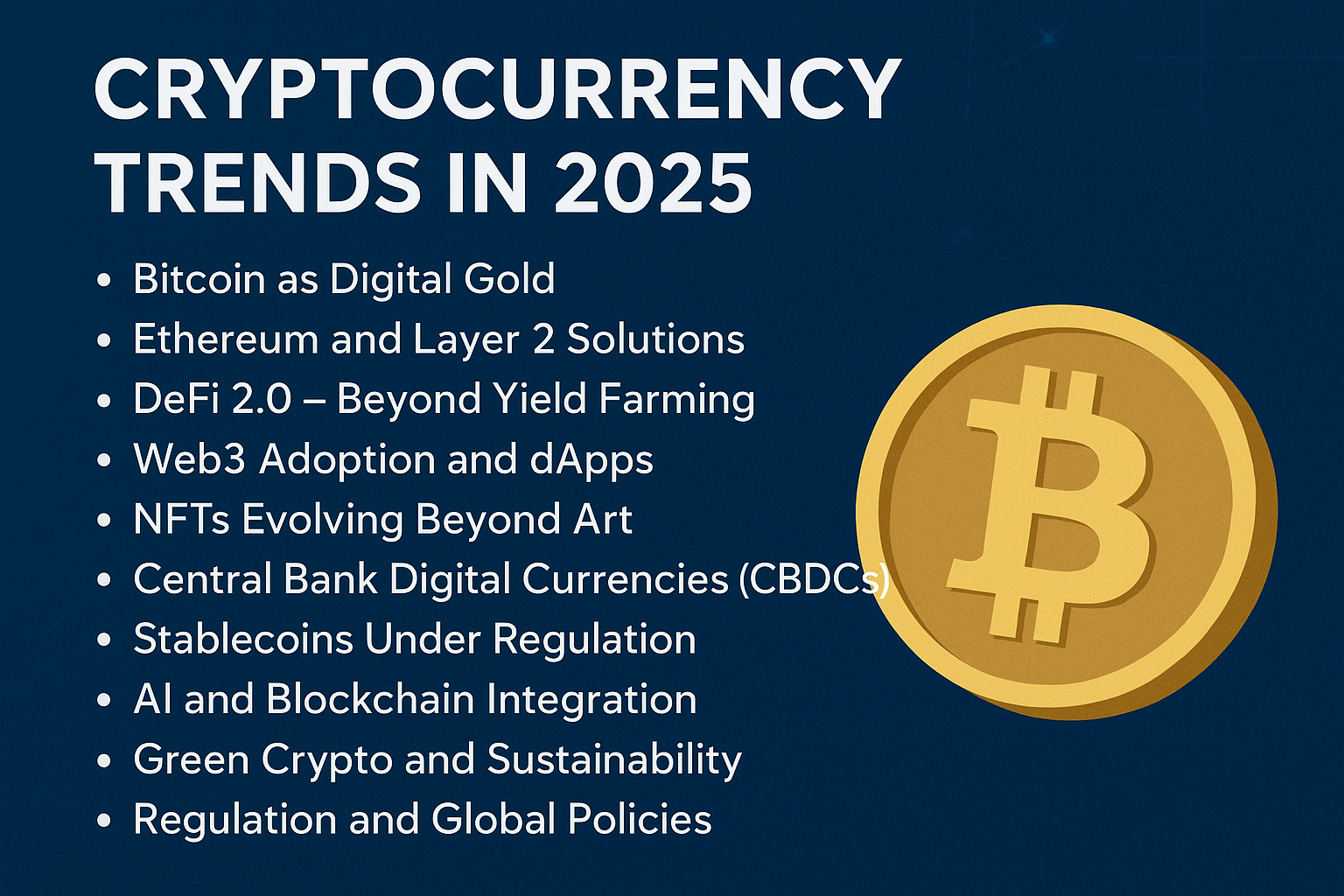
The cryptocurrency world is evolving faster than ever. From decentralized finance (DeFi) to NFTs, central bank digital currencies (CBDCs), and regulatory challenges, the market continues to reinvent itself with new opportunities and risks. As we step deeper into 2025, businesses, investors, and tech enthusiasts are closely following crypto trends that may redefine the financial ecosystem.
In this article, we’ll explore the top crypto trending topics in 2025. We’ll cover blockchain innovations, government regulations, Web3 developments, environmental debates, and more.
1. Bitcoin’s Role as “Digital Gold”
Bitcoin remains the most recognized and widely adopted cryptocurrency. Its role has shifted from being a transactional currency to a store of value, often compared to gold.
Why It’s Trending in 2025:
- Institutional Adoption – Major corporations and funds continue to add Bitcoin to their balance sheets.
- Halving Impact – The Bitcoin halving event in 2024 has led to reduced supply, influencing market prices in 2025.
- Geopolitical Hedge – In times of inflation and economic uncertainty, Bitcoin acts as a hedge against traditional fiat currencies.
The debate continues: Will Bitcoin replace gold, or will it remain a speculative asset?
2. Ethereum and the Rise of Layer 2 Solutions
Ethereum has always been at the heart of the crypto ecosystem, thanks to its smart contracts and decentralized applications. But high fees and scalability challenges pushed the need for Layer 2 solutions.
2025 Highlights:
- Ethereum 2.0 upgrades have improved energy efficiency and scalability.
- Layer 2 protocols like Arbitrum, Optimism, and zkSync are handling more transactions with lower fees.
- DeFi and NFT ecosystems continue to thrive on Ethereum’s infrastructure.
Ethereum remains the backbone of Web3, with developers building innovative applications on top of its network.
3. DeFi 2.0 – Beyond Yield Farming
Decentralized Finance (DeFi) was one of the biggest stories of 2020–2021, but it faced challenges such as security risks, rug pulls, and unsustainable yield farming. In 2025, DeFi 2.0 has emerged with stronger foundations.
Key Features of DeFi 2.0:
- Sustainable Rewards – Reduced focus on high-risk yield farming.
- Improved Security – Protocols with stronger audits and decentralized governance.
- Cross-Chain DeFi – Seamless lending, borrowing, and trading across multiple blockchains.
DeFi 2.0 is positioning itself as a long-term alternative to traditional finance.
4. Web3 Adoption and Decentralized Applications (dApps)
Web3, often called the next evolution of the internet, focuses on decentralization, privacy, and user control.
What’s Driving the Trend:
- dApps – Decentralized applications are offering alternatives to centralized social media, finance, and gaming.
- DAOs (Decentralized Autonomous Organizations) – Communities running projects collectively without centralized leadership.
- Tokenized Economies – Users can earn tokens for contributions, reshaping how digital platforms reward participation.
Web3 is reshaping industries from entertainment to supply chains.
5. NFTs Evolving Beyond Art
Non-Fungible Tokens (NFTs) started as a hype-driven trend in 2021 with digital art and collectibles. By 2025, NFTs have matured with real-world applications.
New NFT Use Cases:
- Real Estate – Tokenized ownership of land and property.
- Music & Entertainment – Artists issuing NFTs for concert tickets, royalties, and exclusive content.
- Gaming – Play-to-earn games with NFT-based items and avatars.
NFTs are no longer just digital art—they are assets powering new digital economies.
6. Central Bank Digital Currencies (CBDCs)
Governments around the world are experimenting with CBDCs—digital versions of national currencies.
2025 Developments:
- China’s Digital Yuan has expanded globally, influencing cross-border trade.
- European Central Bank (ECB) is piloting a digital euro.
- U.S. Federal Reserve continues to explore the digital dollar.
CBDCs raise debates around privacy, government control, and the future of decentralized cryptocurrencies.
7. Stablecoins Under Regulation
Stablecoins like USDT, USDC, and DAI play a critical role in the crypto ecosystem by maintaining a peg to fiat currencies.
Why They’re Trending:
- Regulatory Pressure – Governments worry about stablecoins competing with traditional banking systems.
- Adoption in Payments – Businesses are increasingly using stablecoins for faster, cheaper cross-border transactions.
- DeFi Integration – Stablecoins serve as liquidity backbones in lending and borrowing markets.
Stablecoins remain a battleground between regulators and crypto innovators.
8. AI and Blockchain Integration
Artificial intelligence and blockchain are two transformative technologies converging in 2025.
Key Trends:
- AI-Powered Smart Contracts – Contracts that can adapt to changing conditions.
- Decentralized AI Marketplaces – Users selling AI models and training data securely.
- Fraud Detection – AI enhancing blockchain security against scams and hacks.
The synergy between AI and blockchain is opening new frontiers for innovation.
9. Green Crypto and Sustainability
Crypto mining has long been criticized for its environmental impact, particularly Bitcoin. In 2025, there’s a shift towards eco-friendly crypto solutions.
Trends to Watch:
- Proof of Stake (PoS) – Adopted widely as an alternative to energy-heavy Proof of Work.
- Carbon-Neutral Mining – Mining companies using renewable energy.
- Green Tokens – Cryptocurrencies specifically designed to fund sustainability projects.
The industry is working to shake off its “energy hog” image and align with global sustainability goals.
10. Regulation and Global Policies
Regulation has always been a hot topic in crypto. In 2025, governments are taking stronger stances.
Major Developments:
- Taxation Frameworks – Clearer guidelines for crypto investors.
- KYC/AML Requirements – Stricter rules for exchanges to prevent illegal activities.
- Security Laws – Preventing fraudulent ICOs and scam projects.
The balance between innovation and regulation remains one of the most debated crypto topics.
11. Gaming and the Metaverse
The metaverse is reshaping how people interact in digital spaces, and crypto is powering its economy.
2025 Highlights:
- Play-to-Earn Games – Players earning real income through NFTs and tokens.
- Virtual Land Ownership – Platforms like Decentraland and The Sandbox selling tokenized land.
- Metaverse Payments – Cryptocurrencies serving as the primary payment method inside virtual worlds.
Crypto and gaming are merging into a new digital lifestyle.
12. Privacy Coins and Digital Freedom
Privacy-focused cryptocurrencies like Monero (XMR) and Zcash (ZEC) remain relevant in 2025.
Why Privacy Coins Trend:
- Rising Surveillance – Governments monitoring financial transactions.
- Freedom Advocacy – Individuals using privacy coins for anonymous, censorship-resistant transactions.
- Regulatory Challenges – Many exchanges face pressure to delist privacy coins.
Privacy coins raise tough ethical questions: Should financial privacy be a right, or does it pose risks to security?
13. Cross-Chain Bridges and Interoperability
As multiple blockchains grow, interoperability is becoming crucial.
2025 Solutions:
- Cross-Chain Bridges – Allowing assets to move between Ethereum, Solana, Polkadot, and other blockchains.
- Multi-Chain Wallets – Giving users seamless access to different blockchains.
- Universal dApps – Applications that function across multiple ecosystems.
The future of crypto will be multi-chain rather than dominated by a single blockchain.
14. Real-World Asset Tokenization
One of the biggest crypto innovations in 2025 is tokenization of real-world assets (RWA).
Examples:
- Stocks and Bonds – Traded as tokens on blockchain platforms.
- Commodities – Gold, oil, and even agricultural goods being tokenized.
- Real Estate – Investors buying fractions of properties via tokens.
Tokenization is democratizing access to traditionally exclusive markets.
15. The Future of Work and Crypto Payments
Crypto adoption in payroll and freelancing has grown significantly.
Trends in 2025:
- Remote Freelancers Paid in Crypto – Eliminating currency exchange issues.
- Crypto Payroll Systems – Companies offering salaries in stablecoins or Bitcoin.
- Gig Economy Integration – Platforms allowing workers to withdraw in crypto.
This is transforming how individuals earn, save, and spend money globally.
Final Thoughts
The crypto industry in 2025 is more dynamic, regulated, and integrated with real-world systems than ever before. From Bitcoin as digital gold to DeFi 2.0, NFTs beyond art, AI-blockchain convergence, and CBDC debates, the space is expanding rapidly.
While challenges like regulatory uncertainty and security risks remain, the opportunities are massive. Whether you’re an investor, developer, or simply a curious observer, staying updated on these crypto trends will be essential.
The future of finance is decentralized, innovative, and inclusive—and crypto continues to be at its core.
