
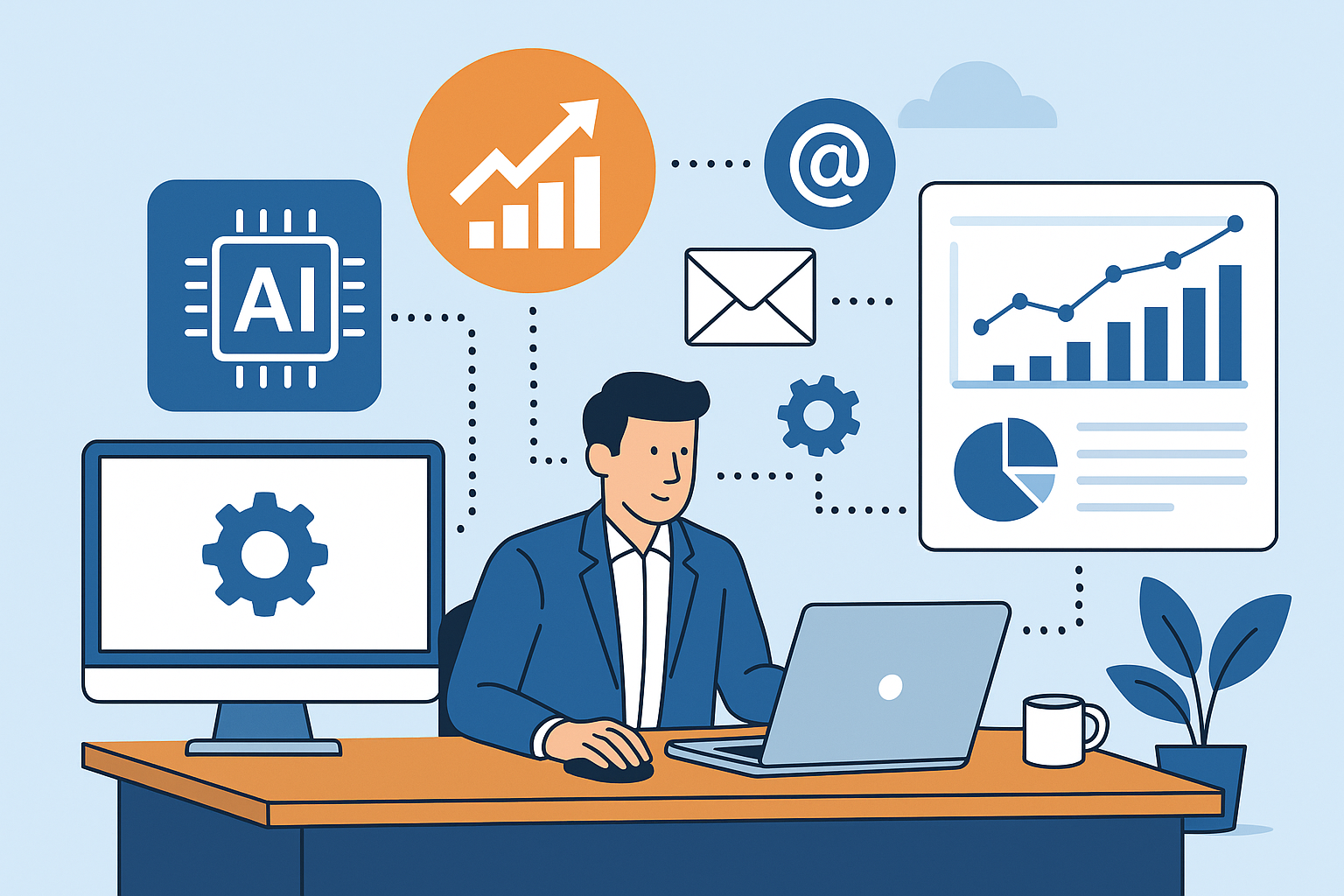
Artificial Intelligence (AI) is no longer a futuristic concept — it’s the driving force behind business growth in 2025. From automating workflows and predicting customer behavior to optimizing marketing campaigns and analyzing data, AI tools are now essential for every modern enterprise.
In today’s hyper-competitive world, companies that embrace AI are outperforming those that don’t. Because of its ability to process massive amounts of data, identify patterns, and generate insights in seconds, AI gives businesses a competitive edge that human effort alone cannot match.
In this in-depth article, we’ll explore how AI tools are revolutionizing business operations, discuss the top AI solutions available, and uncover how organizations can implement them to drive sales, cut costs, and improve efficiency.
💡 What Are AI Tools for Business?
AI tools are software applications powered by machine learning (ML), natural language processing (NLP), and deep learning that perform intelligent tasks usually requiring human thought. These tools analyze data, learn from user input, and make recommendations or decisions based on context.
In business, AI tools help in:
- Automating repetitive tasks.
- Enhancing customer experience.
- Improving marketing and sales strategies.
- Making smarter financial decisions.
- Predicting future trends.
The best part is that AI tools are now accessible to businesses of all sizes — not just tech giants. Whether you’re a small startup or a global brand, there’s an AI solution designed to fit your needs.
🚀 Why AI Is a Game-Changer for Businesses
Artificial Intelligence is transforming how businesses operate, make decisions, and connect with customers. Here are the top reasons why AI has become an essential part of business strategy in 2025:
1. Automation Boosts Productivity
AI tools automate repetitive processes like data entry, scheduling, or lead tracking. As a result, employees can focus on creative and strategic tasks that add real value.
2. Data-Driven Decision Making
AI analyzes massive datasets in seconds. With predictive analytics, businesses can make informed decisions based on facts instead of assumptions.
3. Improved Customer Experience
From personalized recommendations to 24/7 chatbot support, AI helps businesses build stronger relationships with customers.
4. Cost Reduction
AI reduces human error, saves time, and optimizes resource allocation — leading to lower operational costs.
5. Competitive Advantage
Companies that adopt AI early can adapt faster, understand markets better, and outperform competitors in both speed and accuracy.
🧠 How AI Tools Are Used Across Business Departments
Let’s explore how AI is reshaping major business functions across industries.
🏢 1. Marketing and Advertising
AI is transforming digital marketing by helping companies reach the right audience with the right message at the right time.
Popular Use Cases:
- Predictive analytics for campaign performance.
- Personalized content recommendations.
- AI-generated ad copy and visuals.
- Audience segmentation and targeting.
Top AI Tools:
- Jasper AI – for automated content creation.
- SurferSEO – for SEO optimization and keyword analysis.
- AdCreative.ai – for generating high-performing ad creatives.
- HubSpot AI – for marketing automation and lead scoring.
Example:
A Shopify store using Jasper AI can automatically generate product descriptions optimized for search engines, saving hours of manual work while increasing organic visibility.
📞 2. Sales and Customer Relationship Management (CRM)
AI-driven CRM tools are changing how sales teams identify leads, track conversions, and close deals.
Popular Use Cases:
- Lead scoring and prioritization.
- Predicting customer purchase intent.
- Personalized outreach automation.
- Voice and chat-based assistants for customer support.
Top AI Tools:
- Salesforce Einstein – integrates AI into your CRM for real-time predictions.
- HubSpot CRM – uses AI for email personalization and forecasting.
- Zoho Zia – offers conversational analytics and smart recommendations.
- Drift – provides AI-powered chatbots for sales automation.
Example:
A real estate firm using Zoho CRM can identify which prospects are most likely to buy based on previous interactions, improving close rates by up to 40%.
📊 3. Business Analytics and Data Science
Businesses run on data, but analyzing it manually can be time-consuming and error-prone. AI solves this by turning raw data into actionable insights.
Popular Use Cases:
- Predictive trend analysis.
- Risk assessment and forecasting.
- Customer segmentation and behavior analysis.
- Real-time dashboards and reports.
Top AI Tools:
- Tableau with Einstein Analytics – integrates predictive AI insights.
- Power BI with Copilot – provides automated reports and analysis.
- Google Cloud AI – helps analyze large data sets at scale.
- IBM Watson Analytics – provides AI-powered visualization and predictions.
Example:
A retail chain can use Power BI Copilot to analyze daily sales data, forecast future demand, and automatically adjust inventory.
💬 4. Customer Support and Service
Customer service is one of the most transformed areas thanks to AI chatbots and virtual assistants.
Popular Use Cases:
- AI-powered chatbots for instant support.
- Sentiment analysis in feedback.
- Automated complaint resolution.
- Email sorting and prioritization.
Top AI Tools:
- Zendesk AI – for customer service automation.
- Intercom Fin – advanced chatbot using AI.
- Drift AI – for real-time support and lead capture.
- ChatGPT – for personalized conversational experiences.
Example:
E-commerce brands use AI chatbots to handle 80% of customer queries automatically, improving response time and satisfaction.
💵 5. Finance and Accounting
AI simplifies complex financial operations while improving accuracy.
Popular Use Cases:
- Fraud detection and prevention.
- Automated bookkeeping.
- Invoice scanning and payment reconciliation.
- Predictive financial forecasting.
Top AI Tools:
- QuickBooks Online Advanced – with AI-based insights and automation.
- Xero AI – simplifies accounting workflows.
- Planful – for financial planning and analysis.
- Kensho – used in financial markets for analytics.
Example:
A startup can use QuickBooks AI to automatically track transactions, categorize expenses, and forecast cash flow — reducing time spent on manual accounting.
👩💼 6. Human Resources (HR)
AI has redefined how companies hire, retain, and manage talent.
Popular Use Cases:
- Automated resume screening.
- Predictive employee performance analysis.
- Employee engagement tracking.
- Personalized learning and training paths.
Top AI Tools:
- HireVue – for AI-driven video interviews.
- Workday AI – for workforce analytics and HR automation.
- Eightfold AI – for intelligent talent matching.
- BambooHR – with integrated AI for HR workflows.
Example:
A company using Eightfold AI can automatically identify the best candidates for open positions by analyzing skill patterns and past performance data.
🧩 7. Operations and Supply Chain Management
AI ensures smooth operations by predicting demand, optimizing inventory, and automating logistics.
Popular Use Cases:
- Real-time inventory tracking.
- Route optimization for delivery.
- Predictive maintenance.
- Supply chain risk management.
Top AI Tools:
- Llamasoft (Coupa) – for supply chain planning.
- Blue Yonder – for demand forecasting.
- E2open – for logistics and data-driven decisions.
- Infor Nexus – for end-to-end supply visibility.
Example:
A manufacturing company using Blue Yonder can forecast raw material needs based on historical data and seasonal demand — reducing waste and costs.
🧠 Emerging AI Trends in 2025
AI continues to evolve rapidly. Let’s look at the major trends shaping the business world in 2025 and beyond.
⚙️ 1. AI-Powered Automation Everywhere
Businesses are automating repetitive tasks — from HR to marketing — using tools like Zapier AI and UiPath. This not only saves time but also minimizes human error.
📈 2. Predictive and Prescriptive Analytics
AI tools now not only analyze what happened but also predict what will happen next. Predictive analytics helps businesses make proactive decisions instead of reactive ones.
🗣️ 3. Conversational AI and Voice Assistants
Virtual assistants like ChatGPT, Google Bard, and Alexa for Business are transforming customer interaction and internal communication.
💬 4. AI in Content Creation and Marketing
AI-generated blogs, videos, and ad creatives are becoming mainstream. Tools like Synthesia and Pictory can create marketing videos in minutes.
🧩 5. Generative AI in Product Design
Companies are using generative AI to design new products, predict market fit, and even personalize offerings before launch.
🌐 6. Integration with Cloud Platforms
AI tools now integrate directly with major platforms like Microsoft Azure AI, Google Cloud AI, and AWS Machine Learning, making enterprise AI adoption faster and more scalable.
📊 Advantages of Using AI Tools in Business
- Increased efficiency: Repetitive processes are automated.
- Enhanced accuracy: Reduces human error in data and operations.
- Personalization: Tailors experiences for each customer.
- Scalability: Handles growing workloads seamlessly.
- 24/7 availability: AI-powered bots and systems never sleep.
⚠️ Challenges of AI in Business
While AI brings huge advantages, it also introduces challenges businesses must address:
- Data privacy and compliance risks.
- Dependence on technology and algorithms.
- Skill gaps among employees.
- Initial setup and integration costs.
To overcome these, companies should invest in employee training, ethical AI practices, and reliable data security frameworks.
🧭 How to Choose the Right AI Tools for Your Business
When selecting AI solutions, keep these key points in mind:
- Define clear objectives. Know what you want AI to achieve — whether it’s automation, analytics, or marketing optimization.
- Start small, scale fast. Begin with one department or workflow and expand gradually.
- Check compatibility. Ensure AI tools integrate with your existing systems like CRMs or ERPs.
- Focus on usability. Choose platforms with easy interfaces to minimize training time.
- Monitor performance. Regularly track ROI and performance metrics to ensure measurable impact.
🌍 Real-World Case Studies
🏢 Amazon
Amazon uses AI for personalized recommendations, pricing optimization, and logistics. This AI-driven approach contributes to 35% of its total sales.
🏦 JPMorgan Chase
JPMorgan uses AI (COIN platform) to analyze financial contracts, saving 360,000 hours of legal work annually.
🏥 Mayo Clinic
In healthcare, AI tools assist doctors with diagnosis, patient data analysis, and predictive treatment success — improving efficiency by 30%.
🏁 Conclusion: The AI-Powered Business Revolution
In conclusion, AI is not just a tool — it’s the foundation of modern business transformation. From startups to global corporations, companies that integrate AI into their daily operations gain unmatched efficiency, accuracy, and growth potential.
Whether it’s marketing automation with Jasper AI, predictive analytics with IBM Watson, or customer support powered by ChatGPT — every department can benefit from AI innovation.
The businesses that adopt AI today are not only staying ahead — they’re shaping the future of global commerce.
So, the question is no longer “Should your business use AI?” but rather, “How fast can you implement it to stay ahead?”
